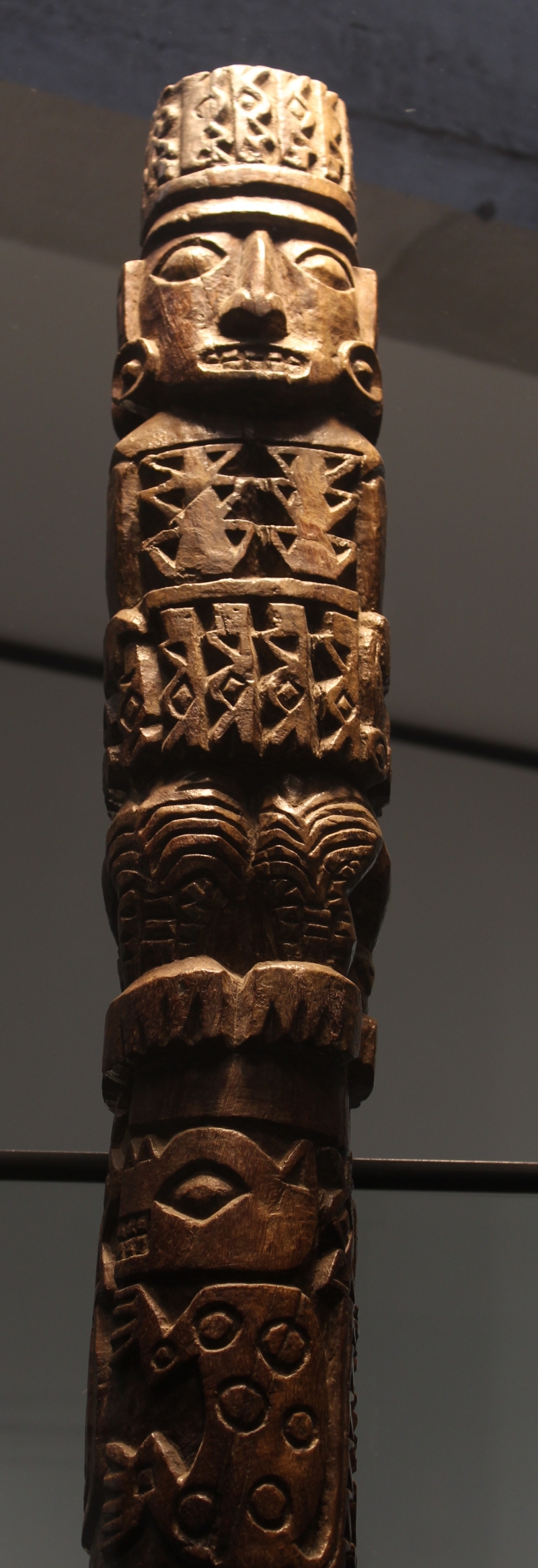
The White God of the Inca peoples, before and after the Spanish colonization.
Welcome back to my blog, I have prepared a short series of posts about the Andean/Inca gods (my favorites as a subject of study and personal veneration for their symbolism mostly associated with the earth and natural phenomena).
Viracocha or Huiracocha, his full name/title in the Quechua language is “Apu Qun Illa Tiqsi Wiraquchan Pachayachachiq Pachakamaq, Apu Kon Illa Teqse Wiraqochan Pachayachacheq Pachakamaq”, that is translated as “the Great Lord, eternal radiance, source of life, knowledge, and maker of the world”.
Also called *The god of staves and rods, he is a divinity of heaven that encompasses the Andean idea of a general "creator god", which would originate from the Caral culture (3100 BC), he is also a central figure of the Puerta del Sol de Tiahuanaco, later venerated as the supreme god within the Inca Empire. He appears as the creator of the world, the sun, and the moon.
He is also credited with creating the "Kamaqen", the substance from which all things that exist in the universe originate. According to the chronicles, Huiracocha "was always here", however, after creating the world, he was "born" from the depths of Lake Titicaca on the shores of the island of the sun.
Image of the God Huiracocha in the Puerta del Sol de Tiahuanaco.
Viracocha created the universe, the sun, the moon, and the stars, time (commanding the sun to move across the sky), and civilization itself. Viracocha was worshiped as the god of the sun and storms. He was represented with the sun as a crown, with rays on his hands and tears that fell from his eyes in the form of rain. According to the Inca cosmogony, Viracocha can be assimilated to Saturn, the "old god", the maker of time, or "deus faber" (maker god), corresponding to the visible planet with the longest revolution around the sun.

The oldest known representation of the God of the Rods was found in 2003 in some broken gourd fragments at a burial site in the Pativilca river valley (Norte Chico region) and the carbon dates back to 2250 BC. This makes it the oldest image of a god found in the Americas.
In Inca mythology, Huiracocha (in Quechua, Wiraqucha) was the invisible and abstract creator deity of the Andean worldview. It was considered as the original splendor (in Quechua, Illa Teqse or The Lord, Master of the World. Actually, it was the first divinity of the ancient Tiahuanacos, who came from Lake Titicaca. It emerged from the waters, created heaven and earth. The cult of the creator god was a concept of the abstract and the intellectual and was destined for the nobility. This god or "Huaca" apparently is also found in the iconography of the inhabitants of Caral, Chavín, and Wari.
"He made mankind by breathing into stones, but his first creation were brainless giants that displeased him. So, he destroyed them with a flood and made humans, beings who were better than the giants, from smaller stones. After creating them, they were scattered all over the world."
Juan de Betanzos.
Huiracocha has considered the most prominent among the Andean gods and his figure is the central one of "La Puerta del Sol de Tiwanaku" (the door of the Sun). It is possible that the great diffusion of it was due to the fact that the Catholic evangelizers were looking for a name to explain the concept of God to the indigenous people. In addition, they added other words to his name in order to emphasize his supreme quality, and in this way, the Quechua name of Apu Qun Tiksi Wiraqucha was formed.
He is believed to intervene in times of crisis but is also seen as a culture hero. The overlapping aspects in the upper pantheon consisting of Wiracocha, Punchao, Inti, and Illapa, could be derived from a single entity of the god of the sky and the storm. Sometimes the aspects have enough differences to worship them in a separate way.
In legend, he had a son, Inti, and two daughters, Mama Killa and Pachamama. In this legend, he destroyed the people around Lake Titicaca with a Great Flood called Unu Pachakutiq, which lasted 60 days and 60 nights, saving two to bring civilization to the rest of the world. These two beings are Manco Cápac, son of Inti (sometimes taken as the son of Viracocha), whose name means "splendid foundation", and Mama Uqllu, which means "mother fertility". These two founded the Inca civilization carrying a golden staff, called 'tapac-yauri'. In another legend, he was the father of the first eight civilized humans. In some stories, he has a wife named Mama Qucha.
Viracocha eventually disappeared across the Pacific Ocean (by walking on the water), and never returned. He wandered the earth disguised as a beggar, teaching his new creations the basics of civilization, as well as working numerous miracles. Many, however, refused to follow his teachings, returning into warfare and delinquency; Viracocha wept when he saw the plight of the creatures he had created.
“Various chronicles and myths describe Huiracocha as "the Maker," a distant and powerful god, but others speak about the appearance of the "mythical hero" and his adventures and pilgrimages.”
Antoinette Molinié-Fioravanti. "The Return of Viracocha."
According to the chronicler Pedro Sarmiento de Gamboa:In the story of the explorer and historian Pedro Sarmiento de Gamboa, there are several descriptions of the creation of the world by Wiracocha. In the beginning, there is one called Wiracocha Pachayachachic. After creating the dark world, giant men are born. When these giants rebel and disobey his orders, Wiracocha Pachayachachic turns them to stone and causes a giant flood that covers the land.
Some of the nations, besides Cuzco, say that some people survived. In the fable of the second age, Wiracocha Pachayachachic saves three people, one of whom is named Taguapácac, and takes his new servants to a lake in Collao and Titicaca Island. He creates the moon, the sun, and the stars. When Taguapaca disobeys him, he is dragged to the bottom of the lake and transformed into a statue of salt. Afterward, the two servants took two different roads, one through the mountain range to the southern sea and the other through the Andes. Wiracocha takes the path among his servants. As they walk, they populate the earth and create the Andean nations. When Wiracocha arrives in the Charcas region, the people there try to kill him. He causes a fire to fall from the sky and many die. Wiracocha extinguishes the fire with his staff, and then the people worship him.
Sarmiento de Gamboa also describes that there are other stories about the creation of Wiracocha. Another says that Wiracocha was created near Titicaca and then he made men and giants in his likeness to populate the earth. They all have the same mother tongue, but after a while, they cannot communicate. After creating the world and people, Wiracocha continues his journey to perform miracles and instruct his servants.
According to the chronicler Juan de Betanzos:The story of Juan de Betanzos is very similar to the myth of Pedro Sarmiento de Gamboa. Huiracocha emerges from Lake Titicaca and creates a race of man. But his creatures enrage him and then he transforms them to stone. Then he creates the sun, the stars, and the moon. Again, he makes men and creates the various provinces of Peru. He forms different lineages of humanity and gives each group a different clothing, language, song, agricultural system, and religion. He sends some men to the mountains, the rivers, and the caves. He orders two of the men to take a specific route to populate the earth. They take the same path as the servants in Pedro Sarmiento de Gamboa's story.
Huiracocha takes the Camino Real that goes to the mountains, towards a region called Caxamalca. He meets a group of people who don't recognize him and then they try to kill him. Huiracocha causes fire to fall from the sky and therefore people are afraid of dying. He tells them that he is their God, the creator, and they begin to worship him. He continues his journey, arriving in Cusco and joining the two men he sent earlier. Together they disappear over the sea.
According to the vision of the traditional Andean chronicle:
Huarochirí manuscript:
The identity of Huiracocha is combined with that of the god Cuniraya in the first chapter of the Huarochirí Manuscript. The addition of the name Huiracocha to worship that idol shows that he was invoked and respected.
The myth that follows explains the exploits of Cuniraya Viracocha and the way he deceives the Huaca Cavillaca: All the huacos wanted her, but she had never slept with any of them. One day, Cuniraya Huiracocha transformed into a bird and planted her male germ in a fruit. Cavillaca ate the fruit and became pregnant without having had sexual intercourse. When she tried to identify the father of her son, Cuniraya Wiracocha appeared as a poor beggar and tried to get her son back. Cavillaca did not believe him and ran out to sea, where she and her son were transformed into islands. Cuniraya Wiracocha tried to find her and asked several animals for help, but she was too late. Upon reaching the sea, she raped the youngest daughter of Pachacamac, another deity. When her mother tried to punish him, he ran away from her. Wandering the land, Wiracocha is known to deceive men.
The White God of the Incas / The arrival of the Spaniards:
The first Spanish chroniclers of the 16th century did not mention any identification with Viracocha. The first to do so was Pedro Cieza de León two decades after the fall of the Inca Empire. Pedro Cieza de León describes Huiracocha as "a white man with a grown body." Similar accounts by Spanish chroniclers claim that Huiracocha had the appearance of a European.
". . . that when asking the Indians what figure this Viracocha had when the ancients saw him there, according to what they had news about it and they told me that he was a tall man with a body and that he had a white garment that gave him to the feet, and that this garment was tight, He had short hair and a crown made on his head in the manner of a priest and was unclothed, and who carried in his hands a certain thing that seems to them today like these breviaries that the priests carried in their hands. . . He asked them what the name of the person in whose place that stone was placed5, and they told me that his name is Con TicI Viracocha Pachaya-chachic, which means in their language, God Maker of the world."
~ Suma y narración de los incas, 1551.
Pedro Sarmiento de Gamboa relates that Huiracocha "was a man of medium height, white and dressed in a white garment like a maiden girded by the body, and he had a staff and a book in his hands."
Juan de Betanzos describes him as “a tall man with a body and a white garment that gave him down to the feet that he wore tight, and that he had short hair and a crown made on his head like a priest... he had something in his hands that seems to them today like these breviaries that the priests carried in their hands”.
Titu Cusi Yupanqui Inca describes the red beards of the Spanish, the animals with silver horseshoes, the written language, and the noise of their arquebuses that connects them with the god of Thunder, Illapa. He then supposes that they were sent by Ticsi Wiracocha. With the discovery that the Spanish were mortal, Titu Cusi reveals that they were commanded by the devil.
Arguments that support these claims include:- The Spanish came from the sea, in the way that Huiracocha and his servants left according to examples in mythology. Huiracocha has a maritime origin.
- According to Fioravanti, the direction of the Spanish path, which begins at sea and goes from north to south, is the inverse of the direction that Huiracocha and his servants (or his children in some versions) took.
- According to Garcilaso de la Vega, Inca Huiracocha, the leader of the Inca people who had this title of Huiracocha as a symbol of their power and relationship with the highest god, delivered a prophecy in which it was declared that one day the Incas would lose their "idolatry and his empire ”at the hands of a people from a distant land.
Other uses of this same name and title:
- Wiraqocha: Supreme God of Tawantinsuyana mythology, represented by a white character with long beards.
- Wiracocha or wiraqucha: God the Inca natives worshiped; and from there, by divine reason, they called the Spaniard's children of that God.
- Wiraqucha is the creator and civilizing god of the Andean world. Spaniards who came to Peru, who received this name, believing them emissaries of the main divinity.
- Huiracocha or wiraqucha: an acculturated term that designated the Spanish. Huiracocha, the southern deity assimilated by the Incas and/or Spaniards to the other Andean cultural heroes, probably for purposes of spiritual subjugation.
Sources:
- Pedro Cienza de León, El señorío de los incas, Lima: Editorial Universo S. A., 1973.
- Pedro Sarmiento de Gamboa, Historia de los incas, segunda parte de la Historia Indica, Buenos Aires: Emecé Editores, 1943.
- Juan Diez de Betanzos, Suma y narración de los incas, Madrid: Marcos Jiménez de la Espada, Imprenta de Manuel G. Hernández, 1880.
- Juan de Santa Cruz Pachacutl Yamqul, Relación de antigüedades deste Rey no del Pirú, en Tres relaciones de antigüedades peruanas, Asunción del Paraguay: Editorial Guaranla, 1950.